Editing through the ages.
Harrison
Sanders Unit 16 Editing
Editing in film has definitely evolved over time, from cutting the actual film with a knife or scissors to doing it all on computers! In this blog we will see the techniques of editing and transition from analogue to digital throughout the years.
When did
editing begin?
Editing started off around the very end of the 19th century and
was featured in the 1898 film 'Come Along, Do!' by Robert
Paul. In the film it had the first shot being of an elderly couple
outside an art exhibition that proceed to walk inside, the 2nd shot is of them
being inside the building.
This technique was achieved by using a sharp instrument like a pair of scissors or a knife.

(Come
Along, Do! Shots)
In 1900 a film called 'As seen through a telescope' was the first
film to feature a POV shot (Point of View shot)

('As seen through a
telescope')
This effect was created by using a camera to film through a
cylinder mask
FILM EDITING AND ITS PROGRESSION

Maviola
In
1924 Iwan Serrurier invented an editing machine called a Maviola. Invented as a
home movie projector its high cost saw it start to fail. However with
adaptations to the design it became the first successful editing machine. It
allowed editors to see all shots in a cutting room and therefore allow them to
decide where to make the best cut. These vertical editing machines were popular
until the 1960s and 1970’s when flatbed editing systems became more common and
allowed editors to watch and cut the film horizontally.
It was in 1934 when the
Academy Awards introduced an additional category called film editing. The first
person to receive an Oscar from the Academy was Conrad A Nervig, in recognition
of his work on the film called Eskimo.
Changes in editing, particularly
in the new popular T.V. medium came in the 1950,s with the introduction of
video. A company called Ampex famous for sound developments and reel to
reel tape machines began developing video tape recorders that set a new high in
T.V. studio standards. Ampex also developed the helical scan concept that led
to home video players. They were also responsible for developing multi-track
recording, slow-motion and instant playback television. The advances made by
Ampex led to the first magnetically recorded
time-delayed t.v. program using the Ampex Quadruplex recording system
in 1956.
In the
1960’s editing became more professional with the introduction of time codes and
electronic editing systems that meant it was possible to edit film or videotape
without the need to cut or splice.
Film
makers continued to use Maviola’s and other standard editing equipment
throughout the 1960’s and 1970’s until developments led to more computerised
systems being developed including the CMX 600 IN 1971. This was the first
nonlinear (NLE) computerised editor.

cmx 600 (NLE)
Throughout the 1970’s
and early 1980’s analogue film remained dominant with video leading the way in
Television however in the Late 1980’s Editing software began to become more
common place and developed throughout the 1990’s to the point that Adobe Premiere
began an era of professional digital editing suites.
Current
progress in the industry is digital filming. The images are recorded onto SD
Cards which can be loaded instantly onto a computer. Although the film industry
still produces a large amount of footage on film before converting it to
digital for editing, there is some clear movement towards digital over film
as the ability to film in higher quality digital gets better. Also the
system of editing is changing. Digital editing software now dominates the
industry and combined with digital film distribution it is clear that digital
advances will mean the end of footage being shot on film other than by
enthusiasts or specific art projects. However there is still an
argument for analogue as a medium to still film, store and save media products
as hard drives have a habit of failure and are more vulnerable to corrupting
and therefore loss of digital information. Savefilm.org is committed to the
survival of analogue footage and recently started an international online
campaign to raise awareness.
Alejandro Bachmann from the Austrian Film Museum
expects analogue film of the future to “no longer have the dominance that it
has enjoyed over the past 120 years. There will, however, still be artists who
are very interested in this medium.”
Unfortunately, editing
can appear to be quite the invisible art, even though editing has been an
important process of film making, since films first began. For that reason it
seems editing fails to get the recognition it so desperately deserves. The main
aim of editing is to engage with the audience by giving the correct
structure and showcasing the shots in order to communicate the director’s
vision and hook the audience in so they keep watching and listening.
The editor needs to firstly be the audience and watch through the audience's
eyes. The editor must therefore understand fully the story in order to
portray and tell this story to the audience. In the early days there
was no clear way to edit media products but after trial and error and many
years of developing techniques editors have learned to be able to convey
meaning or confuse the audience as required by the director. Part of this is
the continuity system, combining shots into logical sequences, creating
motivation as well as the use of transitions between shots in order to
create pace. By cutting from character to character and manipulating how the
viewer’s feel about those particular characters and the subject it keeps the
viewers entertained. The editor using sound and vision develops the drama along
with the director’s vision to fully engage the viewer in a magical experience.
Development
, conventions and techniques
In the early days of cinema editing involved just cutting analogue film footage and putting parts together to form a completed film. Editing went on to develop into much more and change or 'edit' raw footage into a coherent sequence. So for example you see a shot in a scene where it's a close up, then a few seconds later it changes to a mid-shot, this is the work of editing. Editing however can be more than just a simple cut! It can be transitions, effects and music on top of the film. Editing is a process completed in the post production of a film or TV show where the audio and visual material is combined or as in the case of more recent filming processes put in order. Most films or TV shows are not filmed in order and the process to put it into order is known as non-linear editing. Non-linear editing is standard for film making since new developments in technology in the 1990s.
Following the action is
what directors do when filming. The director catches every movement characters
make when moving from location to location. In the early days of cinema one
camera would follow the action in a scene from beginning to end. Now In most
productions there are multiple cameras shooting different shots of the same
action in all the different locations. This gives the editor a range of footage
and shots to make choices for the final edit. During the editing process the editor
will use a range of different camera angles to tell the story. Using shot
variation by changing angles and distances instead of sticking to one continual
shot gives shape, depth and atmosphere to a scene. By making cuts undetectable
and keeping continuity as well as giving the viewer a multi-faceted point of
view by using shot variations, the director keeps the audience’s attention on
the story.
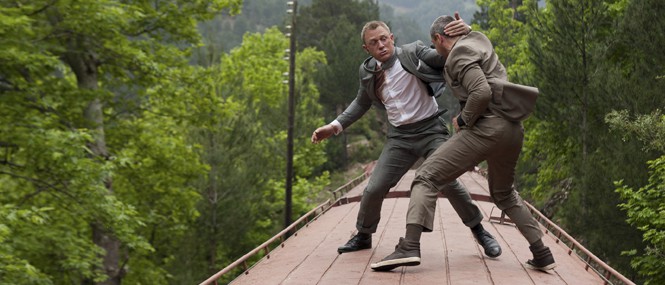
This is demonstrated in
the train fight scene in the film “Skyfall”. Multiple cameras capture the
action from location to location using a range of shot variations. In the edit
they are put together to give the audience an action packed thrill ride.
Keeping the audience’s attention by sharp cuts and shot variations this has to
be one of the best examples of an opening scene to any James Bond Film.

“Skyfall” opening scene
train fight.
In-Camera editing, popular
in the early days of cinema, may still be used today but more typically by a
team on a tight budget. The production team shoots all the required scenes in
order to save time in the final edit .This reduces costs and saves time. It is
used more generally today by independent film makers just starting in the
industry.
Editors use providing and withholding information as a technique
to make the audience intrigued and provide drama. It allows an editor to give
the audience information in small bits to keep them curious and wanting for
more. In the film Skyfall the audience believe James Bond has fallen to his
death in the early opening scenes, coupled with cutting to Adele’s soundtrack
with the words “this is the end” this is the information given The scene fools
the audience and adds a dimension to storytelling to keep the audience curious
and wanting more.

“Skyfall” take the shot,
is James Bond dead?
Cutting to soundtrack is
when an edit point meets up simultaneously with noise spikes in the
soundtrack. It can be a great storytelling technique. Loud or dramatic music
can help to provide the action and drama to a production whereas a slow or tearful
song can build up emotion. This is very evident in the Skyfall opening scenes.

“Skyfall” James Bond’s death.
The 180 degree rule means that
there is an imaginarily line which runs through the middle of every filmed shot
in accordance to the camera position. It is used to avoid confusing the viewers
because if the camera crosses the imaginary line viewer’s perspective is shifted
in such a way that it can confuse them. The line can sometimes be crossed if
there are obvious objects in the scene such as a table or seat so the viewers
can know where all the characters should be in the scene.

The 180 degree rule
Shot reverse shot is when
two different camera angles are edited together which switches back and forth
between characters. This technique is commonly used in scenes which involve
characters having a conversation. In higher quality productions characters in
one frame would be told to look left and then characters in the second frame
would be told to look right. This is to make it look as though the characters
are focussed on each other in the edit. This scene may not always be filmed in
the correct order but would be put together in the edit during post production.
It is important if filming for shot reverse shot that the right number of shots
are filmed to make it work correctly.


Shot reverse shot editing
in “the Dark Night”
Cutaways are an
opportunity to show different visuals which keep the subject matter
entertaining. A cutaway can be used as filler in between shots to
help add information or keep interest to a particular scene.
Different
film shot variety is important to all media storytelling. For an editor one
type of shot is Point of View. This is used to best effect in the Film industry
usually within the found footage or hand held action films particularly in the
Horror genre. In the award winning film “The Blair witch project” the camera
for a lot of the time is in the 1st person prospective and sees what the audience
would see if they were there at eye level. It can give a more realistic feel to
the content and allows for some interesting story telling.

There are a number of
different types of transitions within editing and even in camera. The main
transition is the hard cut. A hard cut is the instant change from one shot to
another. Some camera raw footage can incorporate this transition where filming stops
and then another piece of filming starts.
A motivated edit is when a scene cuts to another scene or
introduces something new that was not in the previous frame. This can be
objects or characters. Sometimes it is done discreetly so that the viewer is
unaware of it happening. Motivated edits can be done with narrative, so a
character can narrate their way into a flashback. It is a technique commonly
used in the horror genre. A character may be disturbed by a sound and yet when
they look in that direction there may be nothing to see, this creates tension
through the edit from having the camera turning to that specific direction.
Cross dissolves are less harsh in transition.
Dissolves are where one shot slowly fades to the next. Fade tends to occur at the
beginning or end of a scene, the transition fades the shot to single colour
usually black, or images. Usually fade in is at the beginning of a scene and
fade out at the end of a scene. Fade can also be combined with the
next scene to create a crossfade. Like fade, a dissolve gradually
changes the visibility of the picture. Rather than transitioning from a shot to
a single colour, a dissolve is a shot changing into another shot gradually.
Dissolves are used to great effect in flashback scenes where someone is telling
a story of something that has previously happened and the scene changes into a
shot of the past. Dissolve or Crossfade are terms used to describe the same
transition. This transition is a gradual fade from one filmed shot to another.
Crossfades or dissolves are a gentler edit and give the viewer more of a
relaxed feel rather than a sharp cut. They tend to be usually used when in need
to show contemplative mood or when filming Landscape sequences or
photomontages. Dissolves can also give the viewers the sense of a change of
location or the passing of time. More recently dissolves have been used to help film studio logos or film company
production cards blend seamlessly into the first shot of the film especially in
action films where the fast paced feel starts immediately the film does. For example
the James Bond film “Skyfall” Uses fade in and fade out as well as dissolves
throughout the opening credits of the film which are shown to the viewers after
initial action has already taken place.

“Skyfall” Dissolve editing technique
A wipe transition is the
progressive replacement of one shot to another in a geometric pattern typically
used to switch locations. It’s a transition used to great effect in Star Wars. There
are different types of wipe transitions, from straight line to complex shapes.
Wipes can often have coloured borders to help distinguish between shots during
the transition.

A wipe edit “Star Wars”
Cross Cutting is used in
good effect in action films or chase scenes. Cross cutting is used when the
action is spread over a distance and to show all the action you need to use
different shots. This is used quite a lot in car chase scenes where the audience
will see a shot of one car and then the film cuts to the other, The action in
both cars is happening at the same time and the editor may use close ups of the
drivers or passengers as well as long shots of the cars.
During some of the action neither characters may occupy the screen but the
viewer knows that one is chasing the other. It is a technique in which
cross cutting occurs between related actions which are happening at the same
time in the same location.
Parallel editing is
similar to cross cutting but unlike all the action happening in the same
location this type of editing concentrates on showing action going on at the
same time but in different locations. This technique was used to great effect
in the film “Inception”
<iframe
width="854" height="480"
src="https://www.youtube.com/embed/KmptU7vEkNU"
frameborder="0" allowfullscreen></iframe>


The
five levels that simultaneously take place in the film “Inception”
Parallel editing in the film gives clear
understanding to the story of “Inception” Through parallel editing
the hard to grasp dreams within dreams are turned into understandable scenes
within scenes within the finished film.
The use of manipulating diegetic time and space
is a technique used to show time unconventionally. Characters may see
images from the past by using flash backs or by using flash forwards characters
can see images from the future. It can also be used to show objects changing or
the environment changing over a period of time. The viewer will know that
something has or is changing.
Seamless editing is two different pieces of film footage placed
together to run smoothly into each other. One filmed shot running into the next
filmed shot without the viewer noticing. An example could be filming two
different shots at two different times, mirroring or copying the first shot
with the second shot and placing the filmed footage together. This would
produce a seamless edit.
Motivated edits are when a scene cuts to another scene or
introduces other objects and people that were not in the previous frame. This
is done discreetly so the viewer is unaware of it happening. Motivated edits
are sometimes allowed by narrative, so someone can talk their way into a
flashback. It is most commonly seen in horror films. The character will hear a
startling sound and yet when they look in that particular direction there is
nothing there, this creates tension just through the edit alone from the camera
turning in that specific direction.
A montage
is a technique in which many filmed shots are edited together in usually a
fast-paced fashion that compresses time, space and information and gives the
viewers a lot of information in short period. Used to good effect in the film
“Rocky” Where the character Rocky trains over a long period of time
using various training methods for a fight but the edit condenses it into a
2mins 43 seconds montage.

Splicing is when two different filmed shots become one continuous
filmed shot, where the first shot finishes and the second begins. This
technique is used when one shot is about to change to another shot to make one
scene be continuous.
Editing rhythm is what editors use to keep the feel of the film
right. The pace of the scene has to match the action going on in the story
being told. Slow cuts have a calming feel to an edit whereas fast cuts edits
have a more aggressive and lively feel. Each series of filmed shots, while
having its own rhythm, also contributes to the pace of the entire film.
Continuity editing is used
to make sure there is a clear continuous narrative for a film or programmes
final cut. The aim is to achieve a smooth run between all of the filmed shots
so t the story is clear and flows without interruption. This avoids the problem
of jump cuts so that objects or characters do not seem to be jumping around
scenes in each shot. It is also used so that the lighting or any background
sounds are not different when switching camera angles in the same scene. For
example an aircraft flying overhead during an outdoor scene can create editing
problems, particularly when different camera angles are required. Usually
filming would stop to allow the plane to pass and the scene re started without
the unwanted background sound. This type of editing creates a seamless run and
helps focus the audience attention on the story being told and not editing
errors.
Relationship
to genre
Most Horror films have some distinct
similarities. Editors add certain techniques during production to identify its
genre. In Horror films editors tend to follow the genre specifics such as the
use of colour particularly clear blue tones across all horror content and the
use of slow shots at the beginning of scenes with sharp fast cuts when any
scares or shocks are revealed. Fast pace editing is regularly used to help
build tension. A common used shot is a low shot to create fear in the chosen
characters. The low shot concentrates on the characters that intimidate others,
have authority or scare others. High shots and close ups in a horror film tends
to show weakness in that character and they tend to become a victim. Motivated
edits are used frequently in this genre with the camera looking away from the
main action quickly to introduce a new character or object when someone hears
something.
A romantic comedy is a genre of film that has
elements of romance and comedy in the film. Basic story follows characters that
meet, fall in love, have some tragedy or break up and then get back together.
Editors tend to follow the same techniques of soft editing as there is no
strong emphasis and a lot of mid shots to show characters body language towards
other characters. Shots tend to be longer so the viewer can catch the whole
story and use the eye line match technique as there are no characters that have
authority over them. Editing is very sensitive and balanced.

Errors
can occur in editing and filming.
Jump
cuts are usually the result of continuity errors. A jump cut can
occur when a cut, that mat have been designed as a camera angle change shows a
continuity error between the two shots. E.G. If a character has a hat on in a
medium shot but not in a close up this detail, which may not have been noticed
during filming of the scene could be obvious to the viewers. In
“Paul” Jason Bateman does a high-speed U-turn on the road,
from distance all is well but when the camera cuts to him driving in close up
it is clear he is driving on the right side of the car, instead of the left
side.

References
https://www.youtube.com/watch?v=eZ_Ki2yfkKQ
Comments
Post a Comment